The Breakdown
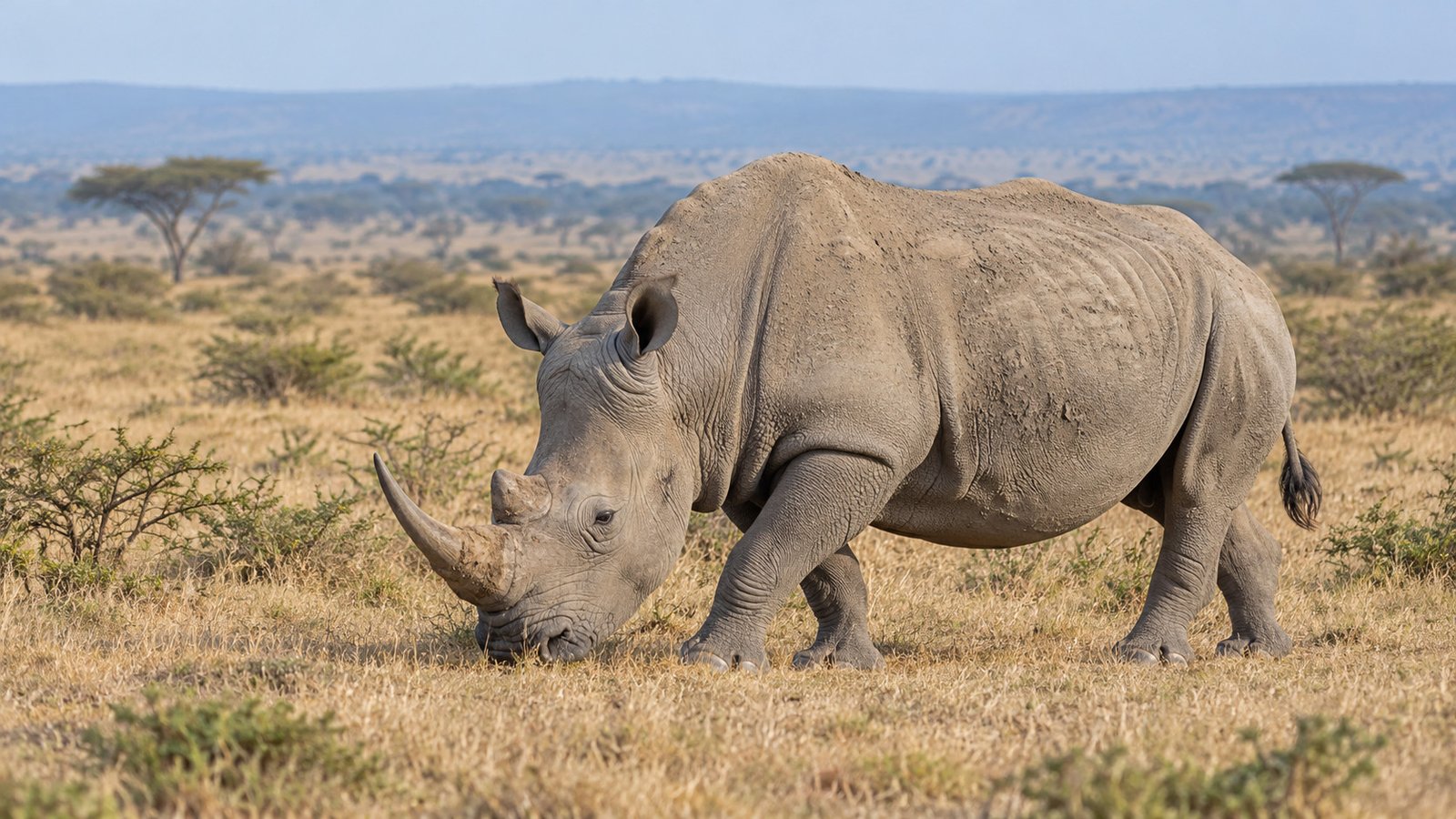
The White Rhinoceros has two subspecies, the Southern White Rhinoceros and the Northern White Rhinoceros. It is best known for its horns, which are also the key reason it is poached. Despite its name, it is not white.
Not actually white, and the name may come from its wide mouth
Despite their name, White Rhinoceroses are grey. The name may come from the Afrikaans word for “wide”, referring to their wide, square mouths, which help them graze on grass.
Its horn is not made from bone
The horn of the White Rhinoceros has no bony core. It is made of keratin, in a structure that resembles horses’ hooves and birds’ beaks, and it grows from the animal’s skin. Its conical shape is thought to come from wear. The oldest part, at the tip, wears away the most, while the softer outer layer wears faster than the harder core inside.
Males and females become sexually mature at different times
Female White Rhinoceroses become sexually mature between ages 4 and 5, but males do not mate until after age 10. After a successful mating, a single calf is born about 16 months later, and a female gives birth to one calf roughly every 3 to 4 years.
Near Threatened as a species, but with the Northern subspecies almost lost
The White Rhinoceros is listed as Near Threatened, with an estimated 10,080 mature individuals in the IUCN’s 2020 assessment. Its northern subspecies, the Northern White Rhinoceros, is considered probably extinct in the wild. The only potential breeding animals left, two females, live in a private conservancy in Kenya, and assisted reproductive methods are being developed in the hope of conserving some of its genes.
The largest living rhinoceros
Guinness World Records names the subspecies, the Southern White Rhinoceros, as the world’s largest living rhinoceros. It can attain a weight of 3.6 tonnes, a shoulder height of 1.85 m and a length of 4.2 m.
Profile
COMMON NAME: White Rhinoceros
SCIENTIFIC NAME: Ceratotherium simum, two subspecies: Southern White Rhinoceros (Ceratotherium simum simum) and Northern White Rhinoceros (Ceratotherium simum cottoni)
HABITAT: Savanna, shrubland and grassland
COUNTRIES: Present today: Botswana, Eswatini, Kenya, Mozambique, Namibia, South Africa, Uganda, Zambia and Zimbabwe. Extinct, possibly extinct or of uncertain presence: Central African Republic, Chad, Côte d’Ivoire, Democratic Republic of the Congo, Senegal, South Sudan and Sudan
SIZE: Up to nearly 2 m tall at the shoulder
WEIGHT: Males about 1,600 to 2,400 kg
DIET: Grass, preferring short grasses
LIFESPAN: Up to 50 years in the wild