The Breakdown
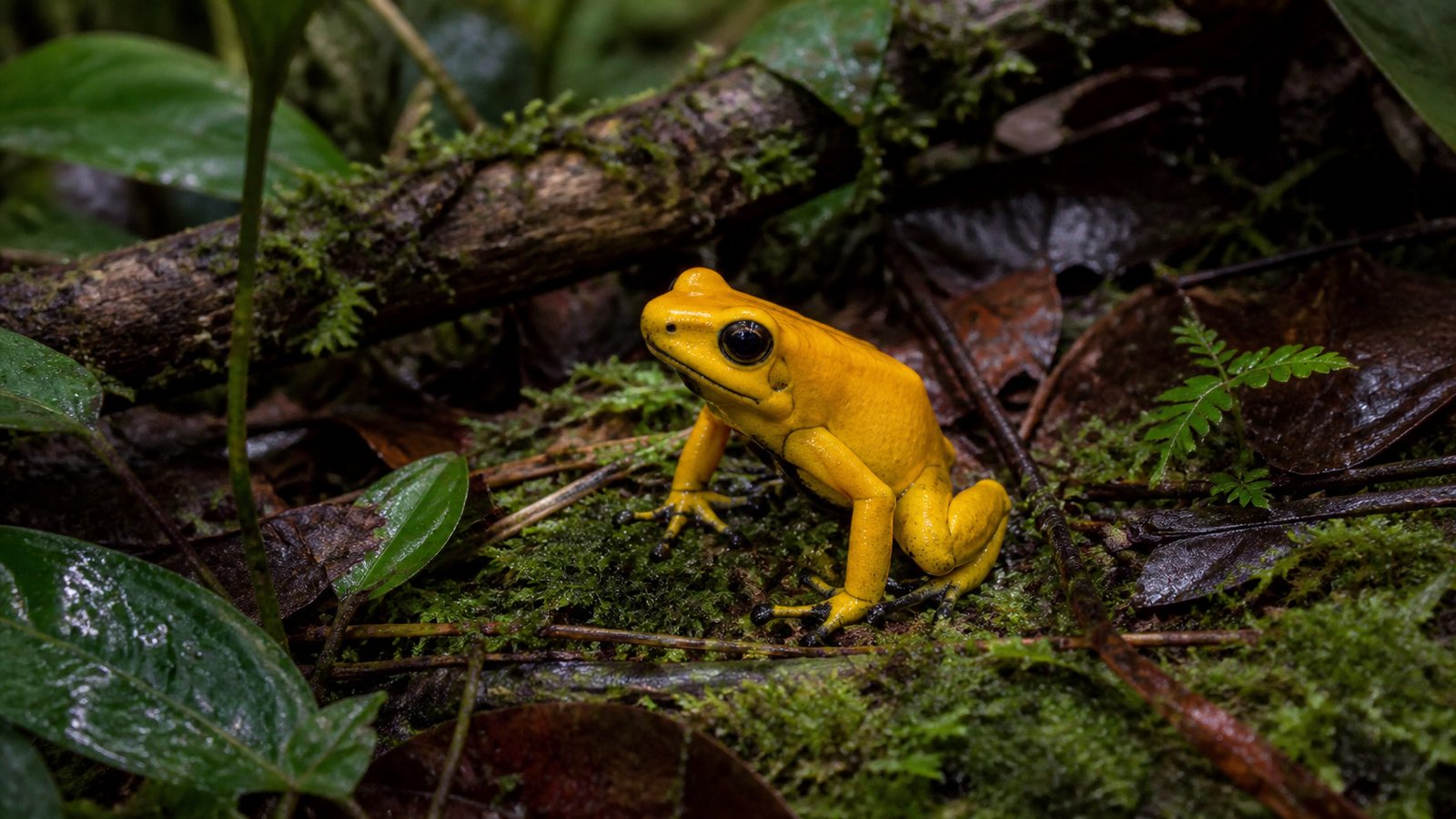
The Golden Poison Frog is the largest species of poison dart frog. They secrete toxin through their skin, which is thought to come from their diet of beetles.
The largest poison dart frog in the world, and currently an endangered species
Golden Poison Frogs are the largest of the more than 100 poison dart frog species, though they still barely reach the size of a human thumb. They’re found in just a small patch of rainforest on Colombia’s Pacific coast — and nowhere else on Earth. Widespread deforestation in the region threatens their survival, and has landed them on the international endangered species list.
Highly toxic poison is likely derived from its diet
Golden Poison Frogs are a species of poison dart frog. They’re so called because some South American tribes use their skin secretions to coat the tips of hunting darts. It’s unclear exactly how they produce this toxic secretion, though it’s thought to be derived from their consumption of beetles, their primary prey in the wild. The same species raised in captivity on a beetle-free diet does not develop the same highly toxic alkaloid secretions.
It can be fatal within minutes once its poison enters your bloodstream
Batrachotoxin from the Golden Poison Frog works by locking nerve and muscle cells in a constant “on” state, so they can’t reset to send the next signal. In humans this causes progressive muscle paralysis, seizures, and respiratory arrest, and can be fatal within minutes to hours once it enters the bloodstream, either through a cut or the mucous membranes. There is no known antidote, and treatment is limited to supportive care, such as mechanical ventilation.
The poison, batrachotoxin, can work as a powerful painkiller with no side effects
Scientists have found that batrachotoxin from the Golden Poison Frog has an analgesic effect — it relieves pain without causing a loss of consciousness. To confirm this, researchers applied a non-lethal amount to volunteers’ skin, causing a tingling sensation followed by numbness that lasted over 30 minutes, with no side effects. Its action on a specific pain-signalling channel makes it a candidate for future topical pain treatments.
A single frog carries enough toxin to kill around 10 adult humans
The Golden Poison Frog holds the Guinness World Record for “most poisonous frog,” with an LD50 (lethal dose 50% — the amount that kills half of test subjects) of just 0.2 micrograms per kg of body weight. For a 70 kg adult, a dose of only 0.014 mg, which is lighter than a single grain of table salt, could be lethal. Despite its size, one frog carries enough toxin to kill around 10 adult humans.
Profile
COMMON NAME: Golden Poison Frog
SCIENTIFIC NAME: Phyllobates terribilis
HABITAT: Damp and swampy lowland rainforests
COUNTRIES: Pacific coast of Colombia, within the Chocó Rainforest
SIZE: 47 to 55 mm
WEIGHT: Under 28 g
DIET: Insectivore — ants, beetles, termites, flies, and others
LIFESPAN: 6 to 15 years