The Breakdown
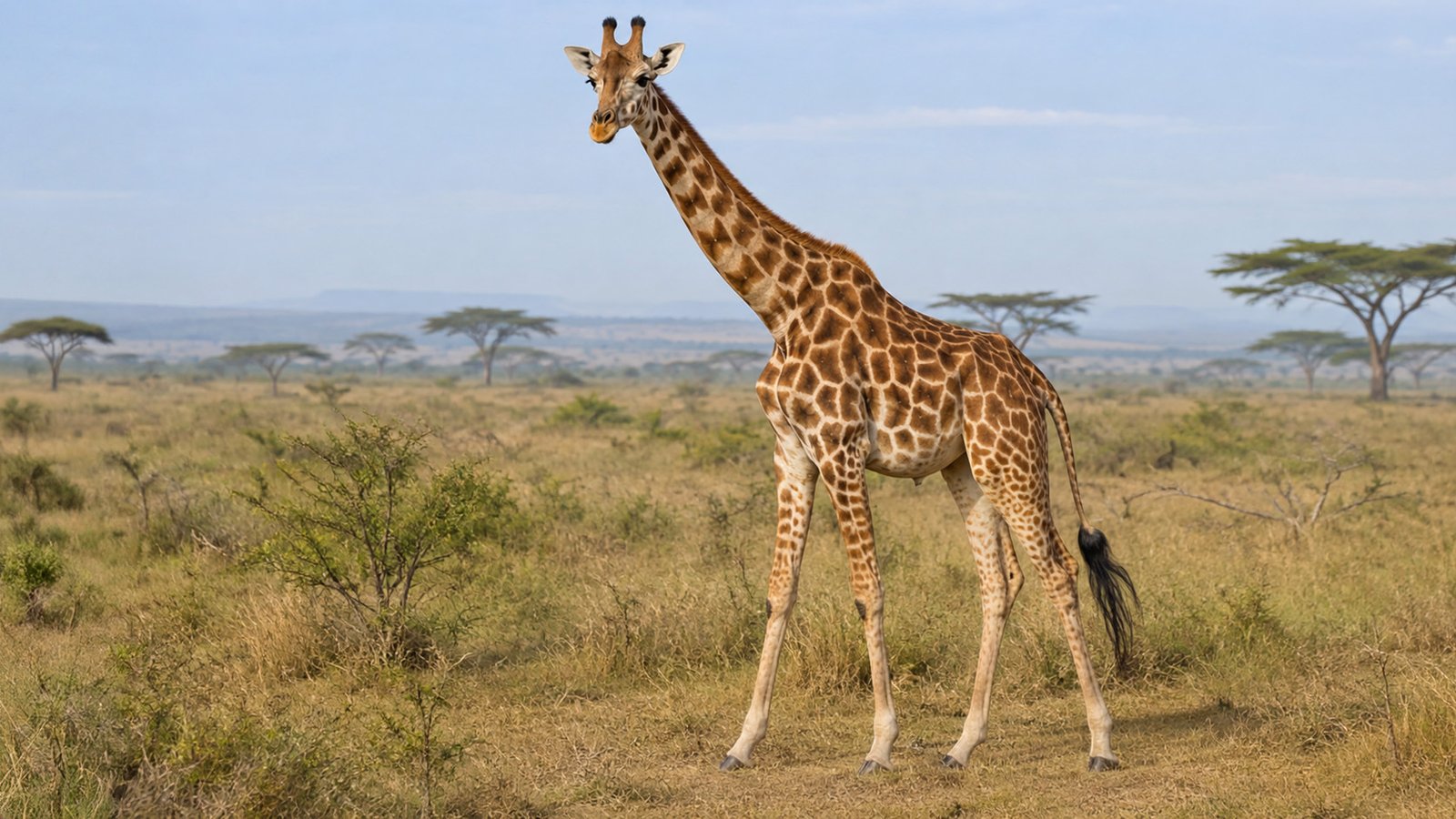
The Giraffe is usually classed as a single species with nine subspecies. It is best known as the tallest living mammal, and its height brings unusual challenges for its survival.
Its height makes taking a drink both difficult and dangerous
To drink at a water hole, Giraffes have to spread their legs and bend down into an awkward position, which leaves them vulnerable to predators such as big cats. Fortunately, they only need to drink once every several days, because they get most of their water from the plants they eat.
A Giraffe's life starts with a fall of around 2 m
Giraffes give birth standing up, so a newborn calf drops around 2 m to the ground the moment it is born. The impact helps break the umbilical cord and prompts the calf’s first breath. Within an hour, the calf is standing and often running, which matters in open country where predators such as lions roam.
Two of its subspecies are Critically Endangered
The IUCN lists the Giraffe as Vulnerable, after its population fell by 36 to 40 percent over 30 years. But two of its subspecies are in a worse position: the Nubian Giraffe (Giraffa camelopardalis camelopardalis) and the Kordofan Giraffe (Giraffa camelopardalis antiquorum) are both listed as Critically Endangered.
The tallest living mammal, with the longest neck
Guinness World Records states that the Giraffe has the longest neck of any living mammal. The neck makes up around one-third of its total height, and averages 1.5 to 1.8 m, though in the largest males it can reach 2 to 3 m. Guinness World Records also lists it as the tallest living mammal, with adult males averaging between 4.6 and 5.5 m tall.
They keep gaining weight years after reaching nearly full height
Giraffes grow to nearly their full height by the age of four, but they keep gaining weight until they are seven or eight. Males can weigh up to 1,930 kg, and their skulls can reach 30 kg. This is because “necking” clashes between males cause mild damage, and bone deposits form around the horns, eyes and back of the skull, building up through life.
Profile
COMMON NAME: Giraffe
SCIENTIFIC NAME: Giraffa camelopardalis, nine subspecies: Angolan Giraffe (Giraffa camelopardalis angolensis), Kordofan Giraffe (Giraffa camelopardalis antiquorum), Masai Giraffe (Giraffa camelopardalis tippelskirchi), Nubian Giraffe (Giraffa camelopardalis camelopardalis), Reticulated Giraffe (Giraffa camelopardalis reticulata), Rothschild’s Giraffe (Giraffa camelopardalis rothschildi), South African Giraffe (Giraffa camelopardalis giraffa), Thornicroft’s Giraffe (Giraffa camelopardalis thornicrofti) and West African Giraffe (Giraffa camelopardalis peralta)
HABITAT: Forest, savanna, woodland and shrubland
COUNTRIES: Present today: Angola, Botswana, Cameroon, Central African Republic, Chad, Democratic Republic of the Congo, Eswatini, Ethiopia, Kenya, Mozambique, Namibia, Niger, Rwanda, Somalia, South Africa, South Sudan, Tanzania, Uganda, Zambia and Zimbabwe. Extinct or possibly extinct: Burkina Faso, Eritrea, Guinea, Malawi, Mali, Mauritania, Nigeria and Senegal
SIZE: Up to 5.8 m tall
WEIGHT: Up to 1,930 kg
DIET: Leaves, stems, flowers and fruits, with Acacia eaten in high proportions
LIFESPAN: Up to 26 years in the wild