The Breakdown
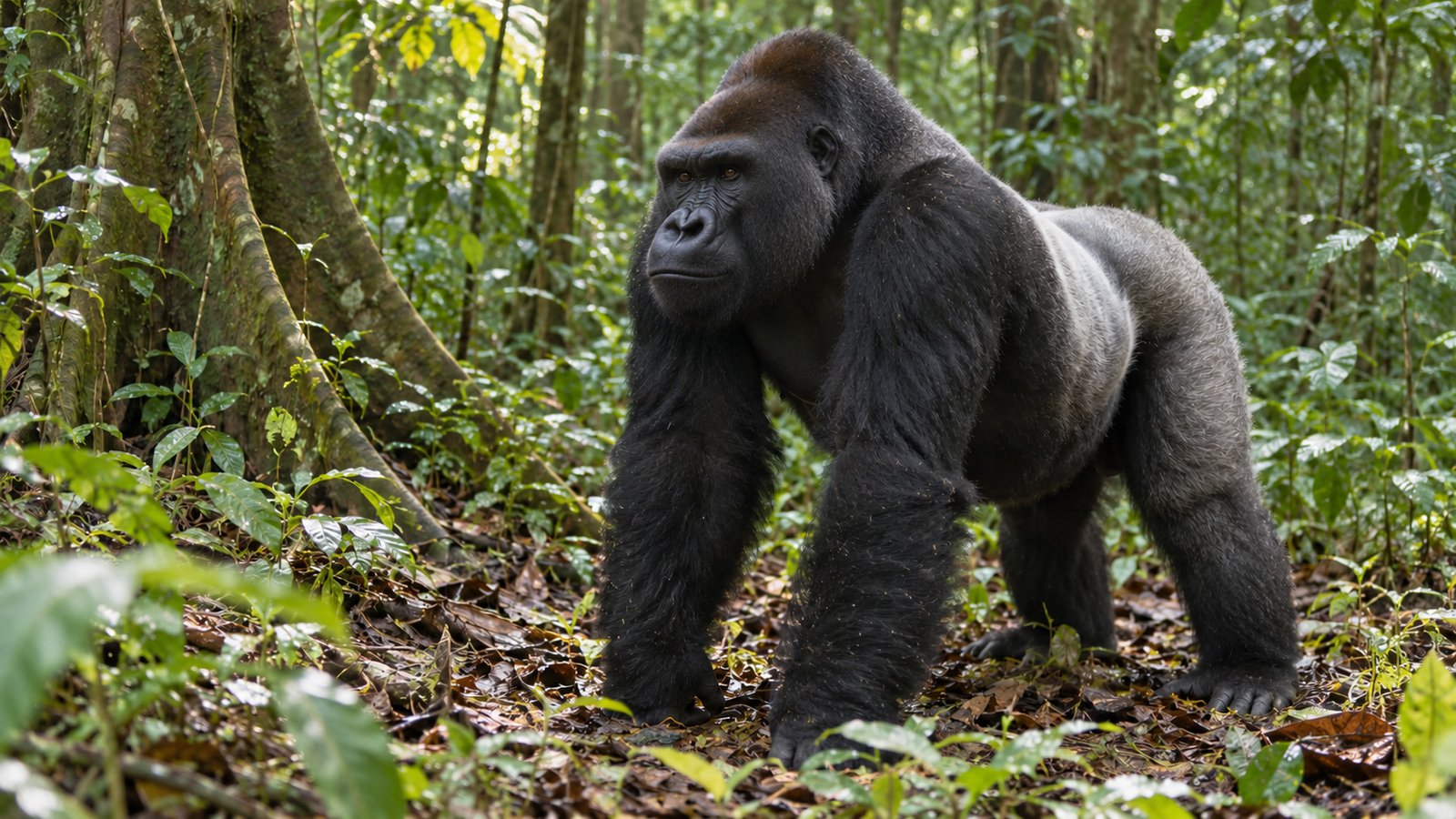
The Western Gorilla has two subspecies, the Western Lowland Gorilla and the much rarer Cross River Gorilla. They are humans’ closest living relatives after chimpanzees.
Our closest relatives after chimpanzees
Gorillas are humans’ closest living relatives after chimpanzees. Researchers sequenced the genome of a female Western Lowland Gorilla and estimated that the gorilla lineage split from the one leading to humans and chimpanzees roughly 10 million years ago, though they note that dating from genetic data remains uncertain.
Builds the largest non-communal nest of any mammal
Western Gorillas hold the Guinness World Record for the largest non-communal nest built by any mammal, spanning up to 1.5 m across. They build a simple nest for daytime rest and a more elaborate one at night.
Capable of using tools in the wild
It has been proposed that animals that can obtain resources by force may not need to rely on tools. In 2004, researchers recorded what they believe were the first observations of tool use in wild Western Gorillas, suggesting that other needs may also prompt tool use in apes. One female used a branch about 1 m long to test the water depth and steady herself while crossing a pool, and another used a tree trunk to support herself while processing food, and as a bridge across swampy ground.
Critically Endangered, with a declining population
The Western Gorilla is listed as Critically Endangered, and its population is declining. At a conservative rate of loss, it is predicted to fall by more than 80% over three generations, about 66 years. The main threats are hunting for bushmeat, infectious disease, particularly Ebola, and habitat loss, including from the clearing of land for agriculture.
Estimated strong enough to lift a 1,800 cc motorcycle
Zoologists believe an adult Western Gorilla, specifically the Western Lowland Gorilla subspecies, has upper body strength roughly six times that of an adult human. Scaled against an average person’s deadlift capacity of 60 kg, that puts a silverback’s theoretical lifting power at up to 360 kg. That would be like lifting a 1,800 cc motorcycle.
Profile
COMMON NAME: Western Gorilla
SCIENTIFIC NAME: Gorilla gorilla, two subspecies: Western Lowland Gorilla (Gorilla gorilla gorilla) and Cross River Gorilla (Gorilla gorilla diehli)
HABITAT: Western Lowland Gorilla: Swamp and dry-ground lowland forest; Cross River Gorilla: Forest in rough, remote terrain, occasionally using lowland areas between hills
COUNTRIES: Angola (Cabinda), Cameroon, Central African Republic, Congo, Equatorial Guinea (mainland), Gabon and Nigeria
SIZE: Western Lowland Gorilla: About 1.4 to 1.8 m tall; Cross River Gorilla: Estimated 1.4 to 1.7 m tall
WEIGHT: Western Lowland Gorilla: About 58 to 170 kg; Cross River Gorilla: Estimated 100 to 200 kg
DIET: Western Lowland Gorilla: Staples are plant pith, leaves and shoots, with fruit varying by season, plus some ants and termites; Cross River Gorilla: Staples are herbs and bark, with fruit when seasonally abundant
LIFESPAN: About 35 years in the wild; up to 50 years in captivity